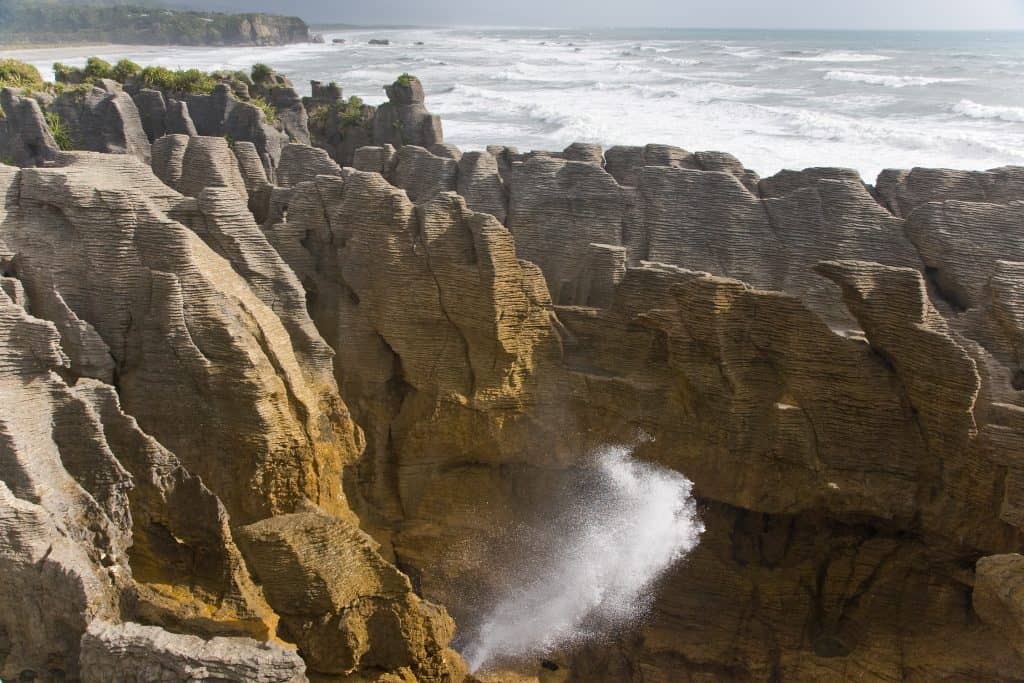
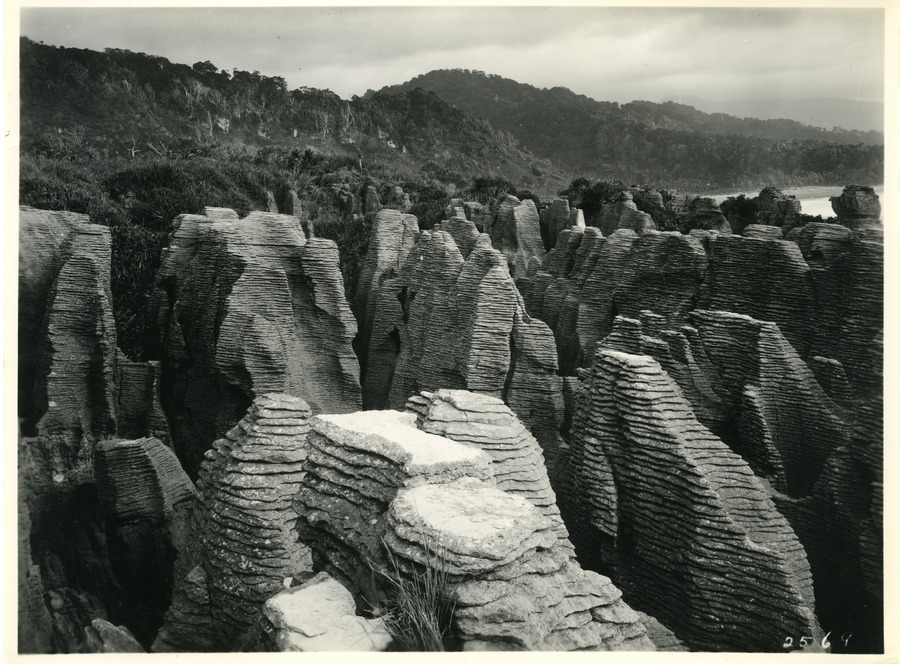
If you’re driving the Great Coast Road between Greymouth and Westport, pull in at Dolomite Point in Punakaiki — this is the one stop nobody skips. The Pancake Rocks look exactly like their name: towering stacks of limestone sliced into thin, wafer-like layers, as if someone piled a giant stack of pancakes right on the coastline.
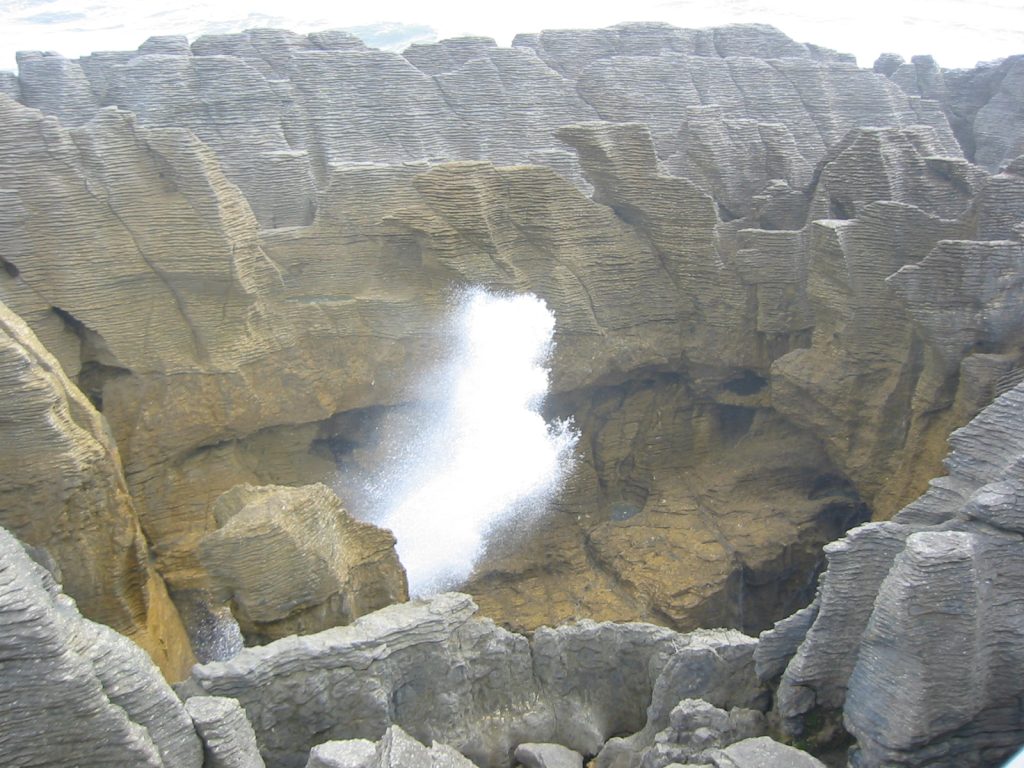
The geology is the real story here. These layers started forming over 25 million years ago, when marine shell debris settled on the seafloor and, under huge pressure, separated into alternating bands of hard limestone and soft mudstone — a process called stylobedding. The softer bands erode faster, leaving the striking pancake-stack effect you see today.
Time your visit around high tide with a south-westerly swell running and you’ll get the full show: waves surge into sea caves below, trap air, and blast water and spray skyward through the blowholes with a boom you can feel in your chest.
The walk itself is an easy, well-formed 30-minute loop from the car park, wheelchair accessible except for one short optional set of steps — genuinely one for all fitness levels, and free to walk. Parking costs $2.50 per half hour or $20 for the day (free if you’re in and out within 10 minutes), and the DOC visitor centre across the road posts daily tide times if you want to plan around the blowholes.
This coastline has long been part of the rohe of Ngāti Waewae (Kāi Tahu), who used the caves and overhangs here seasonally and travelled the coast trading pounamu. A new visitor centre, built with a native-planted green roof, is being handed over to Ngāti Waewae once complete — a fitting next chapter for one of the most photographed stretches of coast in the country.
Photos: W. Bulach, Christian Mehlführer, Anke Lüdtke, Archives New Zealand via Wikimedia Commons.